At Stantonbury School, our curriculum is the vehicle through which every pupil acquires the knowledge, skills, and cultural capital needed to thrive in education, succeed in later life and contribute positively to society. Rooted in high academic expectations and carefully sequenced learning, our curriculum develops deep knowledge whilst cultivating the values that define our community.
Through our curriculum, students develop Intellectual Curiosity by questioning and exploring the world around them, Determined Excellence by striving for their personal best,, Authentic Integrity by acting with honesty and responsibility, Genuine Kindness through respect and empathy for others, and Noble Aspirations by recognising their potential and pursuing ambitious futures.
We believe every child is entitled to a rich, ambitious and carefully planned curriculum that enables them to become confident, knowledgeable and articulate young people who are prepared to flourish, lead with character and make a meaningful contribution to society.
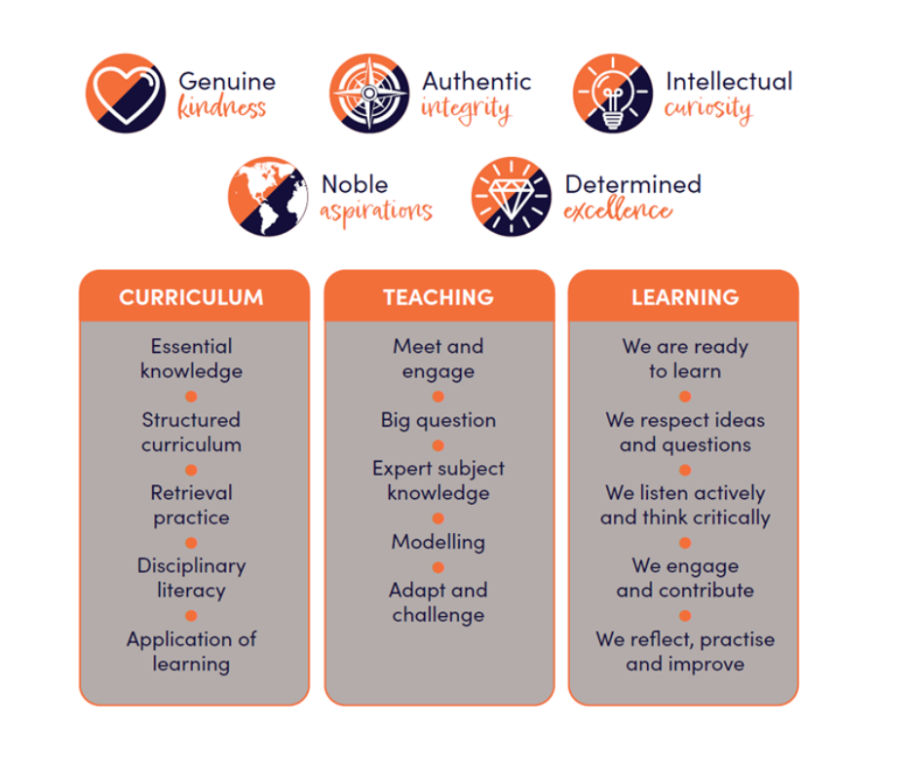
This can be distilled into the following five elements, which are referred to as The Stantonbury Way (Curriculum):
- Essential Knowledge: selecting the most important knowledge and skills within the subject which will help students to progress, and ensuring they are given appropriate time and prominence within the curriculum.
- Structured Curriculum: organising, sequencing and revisiting key concepts within the curriculum to ensure that it builds in complexity and sophistication over time, and learning is retained long-term.
- Retrieval Practice: engaging students in frequent, low-stakes testing which requires them to 'bring to mind' key knowledge, to ensure it is retained long-term.
- Disciplinary Literacy : embedding the skills and knowledge for effective writing, reading and oracy skills, and mathematical skills, within each subject's curriculum area to ensure that students develop and apply this key learning in all areas.
- Application of Learning: planning opportunities for students to process and apply their theoretical learning; for example, into written work, practical activities, vocational scenarios and assessments, to consolidate, prove and review their learning.
Our key curriculum, aims to:
- Place significant emphasis upon the " Essential Knowledge" required to fully understand each subject or curriculum area. It is then sequenced in a logical, coherent fashion which builds upon prior knowledge and paves the way for future learning.
- Develop students’ understanding of the interconnected nature of knowledge and the disciplinary skills required to apply it effectively. By making meaningful connections between concepts, students are equipped to think critically, reason with confidence and make sense of the unfamiliar, drawing upon prior learning to create new understanding.
- Embed retrieval practice and regular review within curriculum delivery so that knowledge is retained in long-term memory by interleaving content to readily apply to future learning.
- Develop students' general, and disciplinary literacy and numeracy skills so that they can articulate their thinking clearly, access ambitious knowledge and succeed in further education, employment and life.
In addition, we also aim to:
- Ensure equal access to learning for all students, with high expectations for every pupil and appropriate levels of challenge and support.
- Championing not just inclusion, equity and anti-discrimination through curriculum content, we strive to ensure our pedagogy, resources and representation, ensuring that students see themselves reflected in the curriculum and school life, and develop an appreciation for others' perspectives and backgrounds.
- Promote a positive attitude towards learning.
- Equip students with the knowledge and cultural capital they need to succeed in life, directly supporting our broader commitment to SMSC (Spiritual, Moral, Social and Cultural) development.
- Develop students' independent learning skills and curiosity, to equip them for future learning and employment.
Relationships and Sex Education
We have developed the RSE curriculum in consultation with parents, students, and staff, taking into account the age, needs and feelings of pupils. If students ask questions outside the scope of this policy, teachers will respond in an appropriate manner so they are fully informed and don’t seek answers online.
The RSE The aims of (RSE) at our school are to:
- Provide a framework in which sensitive discussions can take place.
- Prepare pupils for puberty and give them an understanding of the importance of health and hygiene.
- Help pupils develop feelings of self-respect, confidence and empathy.
- Create a positive culture around issues of sexuality, sexual development and relationships.
- Teach pupils the correct vocabulary to describe themselves and their bodies.
RSE Policy can be found here.
Curriculum Structure by Key Stage
Key Stage 3 (Years 7–9): The Foundation for Achievement
Key Stage 3 provides the crucial foundation for every child’s achievement. The transition from primary school is marked by a move to specialist, subject-specific teaching staff.
All students study a broad curriculum, including:
- English
- Mathematics
- Science
- Design Technology
- Information and Communication Technology (ICT)
- History
- Geography
- Religious Studies
- Modern Languages
- Music, Drama, and Dance
- Food and Nutrition
- Art
- Physical Education (PE)
- PSHCE
Grouping: we teach students in mixed-ability groups as research evidence indicates that this leads to the best outcomes for our students. This means that students mix with a broad range of peers, and can progress as varying rates. We teach some students an additional ‘secondary-ready’ curriculum for English and Maths if they need additional support to master the Key Stage 2 curriculum; we then support the students back into secondary-level lessons as and when they are prepared for them. Over time, we set students in Key Stage 3 Mathematics, as students are different levels begin to study different topics.
Key Stage 4 (Years 10–11)
The list of subjects on offer at Key Stage 4 varies each year based on students’ choices and interests. Subjects on offer include:
- Art
- ASDAN
- Business
- Child Development
- Computer Science
- Drama
- Food and Nutrition
- History
- Geography
- Religious Studies
- Mandarin
- French
- Music
- Physical Education
- Sociology
- Spanish
Both Combined Science and Triple Science GCSEs are offered.
Key Stage 5 (Years 12–13)
Subjects on offer vary yearly based on students’ choices and needs.
This year in Key Stage 5 we are offering:
- History
- English Literature
- Psychology
- Sociology
- Chemistry
- Physics
- Biology
- Maths
- Business
- Economics
- Photography
- Criminology
- Health & Social Care
- Extended Project Qualification
- GCSE English
- GCSE Maths